When You Need Winch-Out & Recovery
Your Vehicle Slid Into a Ditch or Drainage Channel
It happens fast. A missed turn, a narrow shoulder, or a moment of distraction and your vehicle drops off the road into a ditch. The deeper it settles, the harder it becomes to get out under your own power. Spinning your wheels only digs you in further and risks damage to your undercarriage, exhaust, or drivetrain. Our winch-out crews arrive with the equipment and experience to pull your vehicle out safely, getting you back on the road without turning a minor slip into a major repair bill. If the situation involves a collision, our accident towing team can handle the full recovery.
You Slid Off the Road in Bad Weather
Rain-slicked highways, ice patches, and flooded low crossings catch even experienced drivers off guard. When weather pushes your vehicle off the road, the conditions that caused the problem also make recovery harder. Wet grass, saturated soil, and steep embankments require controlled winch pulls with proper anchor points to avoid rolling or further sliding. Our operators work these situations daily and know how to read the terrain, set safe pull angles, and recover your vehicle without making a bad situation worse.
Your Vehicle Is Stuck on a Soft Shoulder or Unpaved Surface
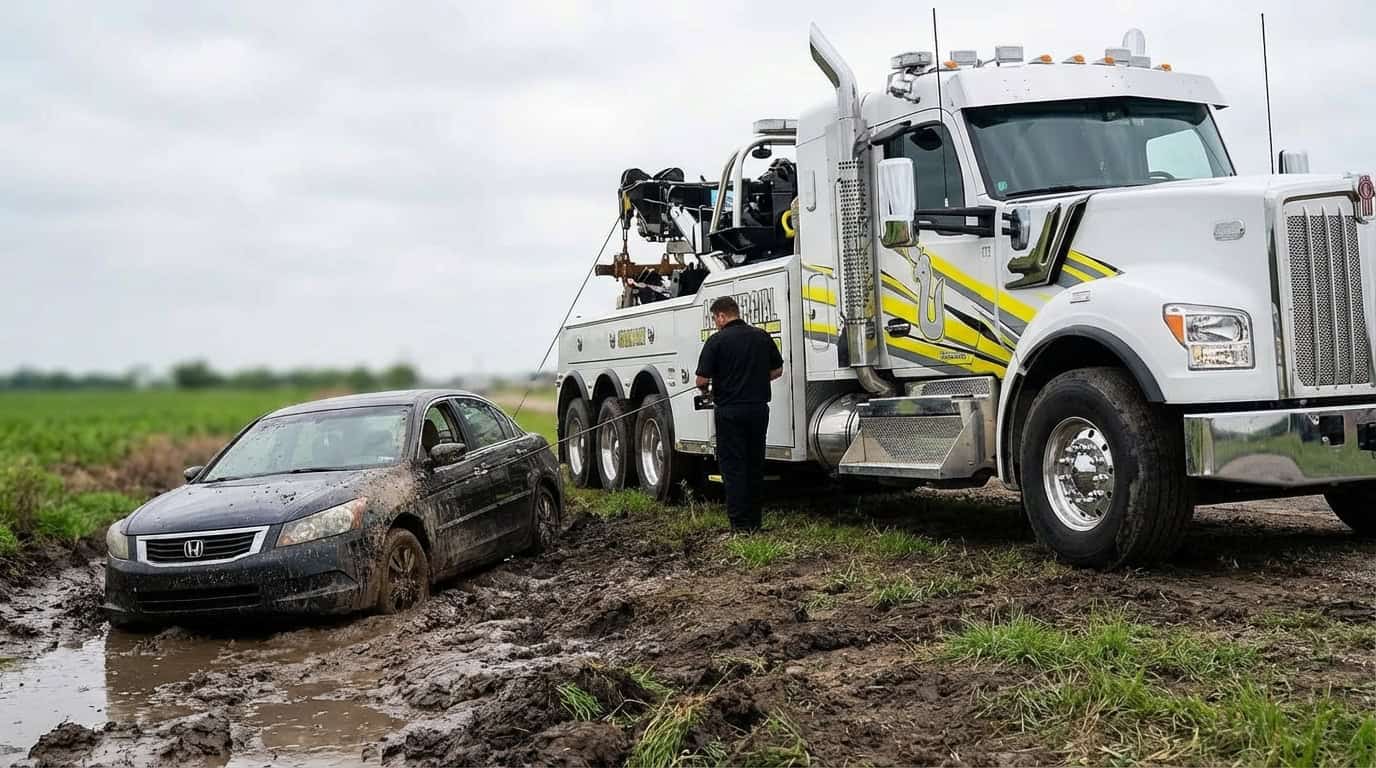
Construction zones, rural roads, and unpaved shoulders can swallow tires quickly, especially after rain. What starts as pulling over to check a map or take a phone call turns into being buried up to the axles. Standard tow trucks often cannot reach these positions safely. Our winch systems extend the reach far beyond the truck itself, allowing us to extract vehicles from mud, sand, gravel, and soft ground without requiring direct truck-to-vehicle contact.
Your Vehicle Is High-Centered on a Curb or Median
High-centering happens when your vehicle’s undercarriage catches on a curb, median, parking block, or uneven surface, leaving your wheels without enough traction to move forward or backward. Attempting to force it free risks cracking your oil pan, bending suspension components, or tearing off exhaust shielding. Our recovery operators lift and guide the vehicle off the obstruction using controlled winch tension, protecting the undercarriage throughout the process. For vehicles that need extra protection during transport afterward, our flatbed towing service keeps all four wheels off the ground.
What We Bring to Every Call
Heavy-Duty Winch Systems
Every recovery truck in our fleet carries industrial-grade winch systems rated for passenger vehicles through heavy commercial equipment. These are not aftermarket accessories bolted onto a pickup. They are purpose-built recovery tools mounted on dedicated platforms, capable of sustained pulling force across long cable runs. Whether your sedan is in a shallow ditch or your work truck is buried in mud, we have the capacity to move it. For the heaviest situations, our heavy-duty towing fleet handles vehicles and equipment up to 50 tons.
Multiple Anchor Points
A winch is only as effective as its anchor. Our operators carry chains, straps, and ground anchors that allow them to establish secure pull points in any terrain. On paved roads, the recovery truck itself serves as the anchor. In soft ground, open fields, or areas without solid structures, our crews set secondary anchor systems that distribute force and prevent the recovery truck from being pulled toward the stuck vehicle. Every anchor is inspected and load-rated before any tension is applied.
Snatch Blocks for Angle Pulls
Not every recovery is a straight-line pull. When a vehicle is stuck at an angle to the road, wedged between obstacles, or positioned where a direct pull would cause damage, snatch blocks redirect the cable path. These heavy-duty pulleys let our operators change the direction of force, doubling mechanical advantage while pulling from a safe angle. This is how we recover vehicles from tight spaces, steep embankments, and awkward positions that would otherwise require multiple trucks.
Damage Prevention Techniques
Getting your vehicle unstuck means nothing if the recovery process causes new damage. Our operators use protective sleeves on cables, soft shackles at attachment points, and careful tension management throughout every pull. We connect to factory-designated recovery points whenever possible and use frame-mounted attachments when they are not available. The goal is always the same: your vehicle comes out in the same condition it went in, minus the mud.
Why It Matters Who You Call
When your vehicle is stuck, the instinct is to call whoever answers first. But winch-out and recovery work is technical. The wrong approach causes real damage, and the wrong operator can turn a simple extraction into a body shop visit. Here is what sets Commercial Towing Services apart:
- Purpose-built recovery equipment — dedicated winch trucks, not tow trucks with an aftermarket winch bolted on as an afterthought.
- Trained recovery operators — every crew member understands load angles, cable dynamics, and vehicle-specific attachment points.
- 24/7 availability — vehicles do not get stuck on a convenient schedule, and neither do we. One call, any time, and we are rolling.
- Transparent process — we explain what we are going to do before we do it, so you understand the recovery plan and the reasoning behind it.
- Full-service capability — if recovery reveals underlying damage, our emergency towing service can transport your vehicle directly to a repair facility without a second dispatch.
What to Expect When You Call
Call us and describe where your vehicle is and what happened. We will ask about the terrain, how deep the vehicle is stuck, and whether there are any hazards nearby. This helps us send the right truck with the right equipment on the first trip. Most winch-out calls are handled with a single crew and a single visit.
When we arrive, the operator assesses the situation, identifies the safest pull direction, sets anchor points, and attaches to your vehicle at designated recovery points. The extraction is controlled and steady. Once your vehicle is free, we check for visible damage and make sure it is safe to drive. If it is not, we handle the tow on the spot. One Call Does It All.